skip to main |
skip to sidebar

It's eight a.m. and I'm by Lake Taupo, eating a petrol station mince pie - I'm taking a quick break before driving on to Kawhia's Maori food festival. My friend Belinda's asked me to grab a pumice stone or two for her garden, so I move to the shore to hunt for some decent sized stones. I spy two shapes on the lake; they see me and start drifting, inexorably, towards me. With a grim sense of foreboding, I focus on them knowing what they are and what they want.
Black swans. My pie.
Suddenly, I know what it must of felt like for the inhabitants of Alderaan as the Death Star moved relentlessly through space towards their planet. I down the remnants of my pie in one gulp, and hastily grab at pumice stones as I make my way back towards the car.
They make landfall. Setting foot on shore, they stand and flex their large, suffocating wings, and fix me with a supercillious glare, affronted by my presence but desirous of my pie. They move towards me, blood-coloured beaks ready to strike like a conquistador's sword.
But I'm in my car, pumice stones on the floor next to me. I sneer at them as I gun the engine and tear off up the road. Nasty, sinister things, black swans - fit only for one thing if you ask me... Onwards to the west coast and Kawhia.

I'm visiting Kawhia's second annual traditional Maori food festival. Last year, this town of 650 people played host to ten thousand visitors. Kai is the principal feature of the event, accompanied by music, kapahaka groups and dance. There are stalls selling and displaying crafts as well. This is a popular cultural event and serves as a showcase for Maori cuisine, both traditional and modern.
Driving over here is a treat. The land is lush and green, easy on the eye after the dry, brown pastures of Hawkes Bay. After what seems like hours of driving on a long, windy main road (change up, change down, change up...), you're met with a view of the harbour and with the sun climbing the sky, this coastal town looks charming and inviting. There's a long queue of cars ahead of me, crawling into town - this event is huge. Parking spaces come at a premium - there are cars on the footpaths, people's front yards - every spare inch is covered. After driving through this busy town, I surrender and end up driving back to its entrance and park next to the main drag, along with the rest of the town's visitors who weren't so fortunate. As I'm locking my car, an SUV passes and arms are thrust out, waving madly - they're friends I haven't seen in a while and I wave back, surprised and pleased. New Zealand is very small.

 Maoris - thousands of them! It's friendly and welcoming and even Don Brash would feel comfortable and compelled to loosen his immaculately fastened tie. There are kids running around, unchaperoned and unshod. There are Pakeha families here, and at least one German and a Czech. The teenagers are dressed in their finest and strut like peacocks, eager to impress. It's hot now and I buy a coke from the dairy and amble, with the throng, towards the festival. It's a beautiful town and I picture myself here with a Maori girl and babies; a little house, a labrador, an unkempt lawn... I fish in my pockets for change and realise I don't have my car keys; no matter, I'm hungry, so I'll panic later.

 The crowd is formidable and they're all expecting to be fed. No one will leave disappointed. There's a raft of stalls and tents. The smells are tempting. Down to business - I pull out my camera and stride towards a stall selling mutton birds, puha and doughboys.
 Mmmm! I haven't had mutton birds for years. They taste exactly as the name suggests, and salty too. The puha is pleasantly astringent, the spud's ok and the doughboys (dumplings for those who were wondering) is spot on. I run into Lucie, and we queue for whitebait fritters.
 The fritter is overly eggy but I'm still grateful to have one, given what they cost during the height of the season. Not bad. Eerily, the eyes follow me across the plate...
 I leave Lucie and head towards a couple of guys selling paua fritters, mussels and other kaimoana. They're showmen and work the crowd with witty banter and blasts of flame from their woks. The air is hot and pungent with the smell of garlic and chilli. The crowd grows as the gentlemen perform. A camera crew watches them work their magic. It smells great and people are feasting.


 My camera starts to play up and I'm fishing in my bag for batteries, but that's not the problem. I line up for hangi after seeing people wandering around with little flax baskets holding chicken, potatoes and kumara. Four different local groups (Rakaunui marae, Mokoroa marae, the Taniwharau Kapa Haka group and the Te Ramaihiko Rangatahi Trust) have put down hangi and each are served at intervals during the day. Mine tastes fantastic - there is something truly unique about chicken and spuds cooked in a hangi. The wee basket is cute - it's a nice touch. My camera decides not to oblige, so no photos.


 While I'm eating, and during the course of the day, music is performed on stage by Ben Tawhiti and The Mariners. The MC, a lady called Aunty Mabel, engages the crowd. At one point, she's joined on stage by her mokopuna who sing and dance. A kapa haka group comes on to perform and fires up the crowd.


Rewena bread! I spend a few minutes talking to the ladies at the stall about their technique - I need to keep baking until it becomes second nature. Practise makes perfect. Their bread tastes sweet and with jam, it's delectable!

 Huhu grubs! A TV crew from Mai Time hovers expectantly as people down these critters.
 Rotten corn! I see some being sold at a stand and grab a pack for my mum, remembering her tales of eating it as a child. It's made by leaving corn in a sack in running water (a creek or similar) for several days, until it turns black having fermented. It's mashed or blended and is eaten like porridge, hot or cold, with a sprinkling of sugar and served with milk or cream. Opening the pack, I quickly discover it lives up to its name (my mother politely declined my offering. Some things, she says, are best left in the past).
 My crayfish - deliciously sweet.

That age-old traditional Maori dessert, watermelon and ice cream.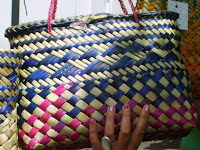
 It wasn't all food - there were carving displays, moko demonstrations and exhibitions of weaving. The festival itself opened with a dramatic haka and karakia and mihi. Raukura Hauora o Tainui, the local health services provider had an information tent, as did Te Wananga o Aotearoa, the multi-campus tertiary institution. There were stalls selling t-shirts, tattoos, lollies, arts and crafts, chips and hot dogs, coffee and the ubiquitous Mr Whippy.
 Bald dude with newspaper hat.
 It was a fantastic day. The weather was perfect (I got sunburnt), the crowd was happy and friendly, the food plentiful, varied and filling. This is an annual event and I really encourage you to go, so mark it in your diary for next year. As much as I love the Marlborough and Martinborough wine and food festivals, the sheer lack of pretension, not to mention the absence of drunk, boorish middle-class prats makes this absolutely refreshing, and most importantly, fun! No black swans, either...

A big thank you to the Kawhia police constable and his instruction in the use of a coat hanger in gaining access to my car keys...
New blog: The Wine Consultant - check out this informative New Zealand blog about the world of wine - well worth a look.

Rewena Bread - Stage 3: Construction / Completion
NB. I've since added some suggestions which may improve the flavour of the bread - a big thanks to Mary from La Tavola.
With my mother installed as overseer and technical advisor, it was time to bake some bread - out came the ingredients:
 1/2 litre of starter/bug (feed the remainder with sugar & water; otherwise pop in the fridge if you're not wanting to make more bread anytime soon)
4 tbspn sugar
1/2 litre of starter/bug (feed the remainder with sugar & water; otherwise pop in the fridge if you're not wanting to make more bread anytime soon)
4 tbspn sugar
5 cups flour
1 tspn salt
Combine dry ingredients and form a well, either in a bowl or on a clean surface. Pour bug into well and mix (yes, that's my mum - she started it and I eventually jumped in).

 Eventually.

You may find you'll need to add water to the mixture if it appears too dry.
 Time to knead the dough; more flour may be required to make it firmer. Kneading serves to further combine the ingredients, as well as distributing tiny air pockets evenly throughout the dough, thus strengthening its structure. Parallels were drawn between my kneading and that of an alsation playing the piano, so again my mother stepped in to show me how it's done (UPDATE - Mary suggested a couple of tips at this point: the dough should be a little sticky - too much flour when kneading can make it dry, as can too much kneading, which should be done for ten minutes at the most).


 Cut (if necessary) and shape your dough. Place in a bowl, cover and leave to prove for a few hours in a warm place (such as the backseat of a 1985 Ford Laser parked in the sun UPDATE - er, this may be a tad too hot: if the proofing temperature is too high, not only will it drive off moisture, but temperatures above 35C stress the yeast - try your airing/hotwater cupboard instead). The dough will by now have almost doubled in size; knead again to remove any large air pockets that may have formed.

Bake at 200 Celsius in a greased loaf tin (which I don't have, hence the improv metal bowl-thingy) for 45-50 minutes. As the baking draws to a close, test the bread with a skewer or knock on the top of the loaf - if it sounds hollow, it's ready.
 Well, it certainly looks impressive, but how did it taste? Bland. The last time I had rewena bread was a loaf I'd bought from the Albert St market in Palmerston North; it was firm and sweet. This, while big and bountiful, tasted a little dry and lacked the distinctive taste of that loaf, the subtle tang combined with its characteristic sweetness. I'm not entirely sure what went wrong - mum attributed it to the potatoes (I used new instead of floury(sp?) potatoes which are meant to be better), or some sort of glitch during fermentation. No matter - this was my first effort and now that I have a bug, I can try again and hopefully develop my rudimentary baking skills.
 A big twenty-one gun salute to mummo for all her help and patience (bless!).
UPDATE - Mary also suggested using a little honey in the dough mixture; it retains moisture, limiting the likelyhood of the dough drying out while also imparting sweetness and flavour (depending on the type you use, say, Manuka).
Rewena Bread - Stage 2: Fermentation

 We have fermentation! There's definitely a reaction going on, with the starter increasing in size by a third! I'm going to have to find another jar. Time to feed it a teaspoon of sugar, mixed into the goo with a knife. Tomorrrow, I'll be adding half a cup of the water from some boiled potatoes. Two more sleeps until the bakeoff!
Rewena Bread - Stage 1: Making the 'Bug'
After persistent badgering and negotiation (with absurd promises made on my part of producing grandchildren within the next five years), my mother very kindly showed me how to make rewena bread, a Maori favourite. Rewena paraoa (potato bread) tastes sweet and has a slight sour/tang flavour to it, a result of the long period of fermentation it undergoes. A bug or starter is created a few days before the actual baking of the bread, using flour, water, sugar and potato (the potato serving as the leavening agent). This is left to ferment which, when finally added to the rest of the bread ingredients to make dough, produces a wonderfully textured, flavoursome loaf.
The starter can be maintained for an indefinite length of time. Once you've made dough, a piece of it can be removed to make the starter for your next batch of bread, adding flour initially and then water and sugar to keep it alive. My mother talked of how as a child, bread was made every two or three days for her and her seven(!) siblings by my grandmother, using a starter which had been kept for as long as she could remember. This article on bread in Wikipedia talks of how some traditional bakers in Europe have starters which are several human generations old!
This, clearly, is a project that will take a few days. To make the starter, you will need:
 -1 medium sized potato ('rewa' in Maori), sliced
-1 cup water
-2 cups of flour
-1 teaspoon sugar
-lukewarm water, on hand
Place your potato in a pot with the cup of water (with the potato being sliced, the cup of water should be sufficient to cover it). Boil until cooked, then leave in the pot until lukewarm (DO NOT drain the water). Mash the potato.
 Gradually add flour and sugar to the pot, mixing all the while until the ingredients are combined resulting in a firm, batter-like paste (you will have to add lukewarm water to the mixture as it gets dry). It will have very small lumps - don't worry, these will break down as the mixture ferments.

Pour the starter into a clean, sterilised agee jar or similar container, cover loosely and leave in a warm place to ferment. Hopefully, it will increase in size so make sure your container is large enough to accomodate it. Over the next day or so, the starter will have to be fed to maintain fermentation: 1 teaspoon of sugar and half a cup of lukewarm potato water. Once it starts to rise and form bubbles, it's time to add the rest of the ingredients to make rewena bread. Come back soon to see if it works!
UPDATE: Don't salt the water when cooking the potato - it negates the fermentation process. Also, if you're able to find some, try using Maori potatoes (taewa maori), of which there are several kinds (PDF file) - try experimenting!
 I paid a visit to 'Waiter Rant', not having read it in quite a while. It's a thoroughly engaging blog written by an anonymous American waiter passing comment on his job, his colleagues, customers and the restaurant he works in, not to mention observations on life and the world at large. Apparently, he's secured a book deal, such is his popularity, having written for his blog since 2004 - well done!
Being a relative newbie to the world of wine etiquette, this post was very helpful to me so I thought I'd share it with you. Equally as interesting as his posts are the comments left by visitors to his blog, often a good source of information, as well as amusement.
 Kawhia, situated on the west coast south of Raglan, has its annual Traditional Maori Kai Festival on the third of February. Maori kai - traditional and modern - are on offer, as well as a raft of cultural events and activities throughout the day (moko demonstrations, bands, kapahaka displays and more). Last year's festival had a record ten thousand people in attendance, with numbers expected to be well in excess of that this year - I shall be there (popping down from Raglan where I'll be staying), camera in hand! It's a part of the country I've never been to, and I'm looking forward to my trip. I'm also packing the pants with the elasticated waist in readiness...
Click here for a map of the area.
The Harvest Hawke's Bay Wine Festival is on that same weekend too. Eat, drink and be merry, kids!


 Maoris - thousands of them! It's friendly and welcoming and even Don Brash would feel comfortable and compelled to loosen his immaculately fastened tie. There are kids running around, unchaperoned and unshod. There are Pakeha families here, and at least one German and a Czech. The teenagers are dressed in their finest and strut like peacocks, eager to impress. It's hot now and I buy a coke from the dairy and amble, with the throng, towards the festival. It's a beautiful town and I picture myself here with a Maori girl and babies; a little house, a labrador, an unkempt lawn... I fish in my pockets for change and realise I don't have my car keys; no matter, I'm hungry, so I'll panic later.
 The crowd is formidable and they're all expecting to be fed. No one will leave disappointed. There's a raft of stalls and tents. The smells are tempting. Down to business - I pull out my camera and stride towards a stall selling mutton birds, puha and doughboys.
 Mmmm! I haven't had mutton birds for years. They taste exactly as the name suggests, and salty too. The puha is pleasantly astringent, the spud's ok and the doughboys (dumplings for those who were wondering) is spot on. I run into Lucie, and we queue for whitebait fritters.
 The fritter is overly eggy but I'm still grateful to have one, given what they cost during the height of the season. Not bad. Eerily, the eyes follow me across the plate...
 I leave Lucie and head towards a couple of guys selling paua fritters, mussels and other kaimoana. They're showmen and work the crowd with witty banter and blasts of flame from their woks. The air is hot and pungent with the smell of garlic and chilli. The crowd grows as the gentlemen perform. A camera crew watches them work their magic. It smells great and people are feasting.

 My camera starts to play up and I'm fishing in my bag for batteries, but that's not the problem. I line up for hangi after seeing people wandering around with little flax baskets holding chicken, potatoes and kumara. Four different local groups (Rakaunui marae, Mokoroa marae, the Taniwharau Kapa Haka group and the Te Ramaihiko Rangatahi Trust) have put down hangi and each are served at intervals during the day. Mine tastes fantastic - there is something truly unique about chicken and spuds cooked in a hangi. The wee basket is cute - it's a nice touch. My camera decides not to oblige, so no photos.

 While I'm eating, and during the course of the day, music is performed on stage by Ben Tawhiti and The Mariners. The MC, a lady called Aunty Mabel, engages the crowd. At one point, she's joined on stage by her mokopuna who sing and dance. A kapa haka group comes on to perform and fires up the crowd.


 Rotten corn! I see some being sold at a stand and grab a pack for my mum, remembering her tales of eating it as a child. It's made by leaving corn in a sack in running water (a creek or similar) for several days, until it turns black having fermented. It's mashed or blended and is eaten like porridge, hot or cold, with a sprinkling of sugar and served with milk or cream. Opening the pack, I quickly discover it lives up to its name (my mother politely declined my offering. Some things, she says, are best left in the past).
 My crayfish - deliciously sweet.


 Bald dude with newspaper hat.


