Showing posts sorted by relevance for query puha. Sort by date Show all posts

Sunday, November 12, 2006

Cooking with Puha

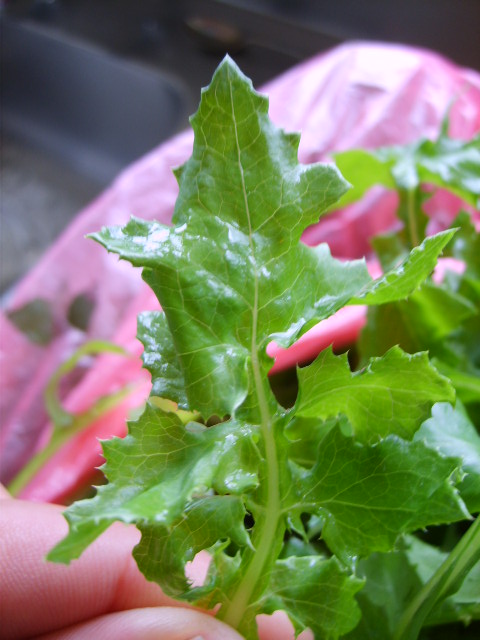
Puha (pronounced "poo-ha")
- aka Sow Thistle (Sonchus)

Puha and Pork Bones

Puha and Sesame Salad

As a child, puha was the bane of my existence. While mums the length of the street would lovingly caw from kitchen windows, "do you kids want sausages or saveloys for tea?", mine would say nothing, employing the power of surprise in the battle to feed her two picky children.

Arriving home in the early evening after hours of play always held an air of dreadful mystery for me and my brother. Unlike the other kids in our street, our mother was Maori, which meant that while the other children in our street always got 'proper' food, we, at least once during the week would encounter something 'different'. This often meant finding a steaming plate of muttonbirds, left-over hangi, paua fritters or if I was unlucky, pork bones and puha.

Sunday, June 24, 2007

Muttonbirds - Titi


Have you ever wanted to try a muttonbird but were too chicken (ah, comedy gold!) to give it a whirl? Take a look at this weeks effort in the kai lab.
First, some background. Muttonbirds, known also as the Sooty Shearwater or Titi amongst Maori, are a member of the petrel family. The origin of the name refers to the mutton-like taste of the flesh, and possibly the woolly appearance of its young. It is the chick that is harvested, found in vast numbers living in the multitude of burrows on the small islands
near Stewart Island (Rakiura). The season starts on the 1st of April and goes through to the 31st of May. All activity is administered by Rakiura Maori (Ngai Tahu) and their sustainable harvest programme. To that end, the bird population is monitored in conjunction with the University of Otago. The harvest is an age-old event for the islanders, being one of the few large-scale harvests of petrels in the world. Consequently, it is of immense significance, providing as it does income, an opportunity for families and those connected to meet, work and socialise together, as well as being an important facet of cultural life for Maori in the South Island.
The process: once the chicks are collected, they are plucked and then the feet and wings are cut off. They are then dipped in wax to help remove the layer of down on the bird's body. Once hardened, the wax is cracked and removed, taking the down with it. The birds are then packed in salt and placed in buckets for shipping to market on the mainland. The birds are expensive and available for a limited time. I bought mine from the Albert street market in Palmerston North; I've seen them for sale at fish markets, non-chain butcher shops and once at Pak 'n' Save in Hastings.


The bird is the size of a very small duck. It's fatty, a feature necessary for a bird soon to spend long periods of time at sea (except this one, obviously). Cooking them takes a wee bit of time. Your kitchen will also become quite pungent for a while. Personally, I don't mind the smell but some people might, so don't say I didn't warn you... I cooked mine with puha and I also made some gnocchi - more on those soon.

Find your puha, wash and put aside. Take your muttonbird and pluck off any downy feathers that may be left. Place in a pot of water - lots of water. Pop the lid on, bring to the boil and then simmer for an hour. Once the hour's up, drain off the water, and repeat the entire process. By the way, are your windows open? Go open them... Or turn your rangehood up to eleven.

Again, once that hour has been reached, drain off the water. As you can see from the photo, the bird possesses an astounding amount of fat, even after that initial change of water; the second change will take care of that though. This time, when refilling the pot with water, you'll only need enough to cover the bird.
Once the bird has simmered for about 30-40 minutes, whip up some gnocchi, dumplings or doughboys. During this time, hurl your puha into the pot with the muttonbird.
Time to cook the gnocchi. Remove the bird from the pot and keep warm - turn the heat up and drop your gnocchi into the pot to cook. While this is happening, remove the skin off the bird and don't play with the light settings on your camera, even if the results look good (deceptively so) on the camera's LCD screen...
Voila! Muttonbird, puha and misshapen gnocchi! It was very tasty - the meat of the bird is quite dark and does indeed taste like mutton. I've read grumbles about muttonbirds tasting overly greasy, salty and/or fishy - patently untrue. Changing the water minimises those potential problems, thus bringing out the flavour of the food as well as making it a bit healthier. If you make this for your family, you might want to remove the bones for your littlies. One bird would feed two people at a stretch, and given the cost (anywhere from $12 to $18 a bird), this is probably a truly seasonal treat (unless you 'know' people).

Other methods of cooking muttonbirds I've encountered involve grilling after boiling (reasonably common), boiling in milk (!) and an odd french story involving boiling in brandy (done presumably because they were French and can get away with that sort of nonsense).

Fancy something a little more flash? Try titi orzo by brilliant New Zealand chef Anne Thorpe.

Take a look at these two personal accounts of muttonbirding from Te Ara: The Encyclopedia of New Zealand and the National Library of New Zealand.

Sunday, February 11, 2007

Kawhia Traditional Maori Kai/Food Festival - 3/2/07


It's eight a.m. and I'm by Lake Taupo, eating a petrol station mince pie - I'm taking a quick break before
driving on to Kawhia's Maori food festival. My friend Belinda's asked me to grab a pumice stone or two for her garden, so I move to the shore to hunt for some decent sized stones. I spy two shapes on the lake; they see me and start drifting, inexorably, towards me. With a grim sense of foreboding, I focus on them knowing what they are and what they want.

Black swans. My pie.

Suddenly, I know what it must of felt like for the inhabitants of Alderaan as the Death Star moved relentlessly through space towards their planet. I down the remnants of my pie in one gulp, and hastily grab at pumice stones as I make my way back towards the car.
They make landfall. Setting foot on shore, they stand and flex their large, suffocating wings, and fix me with a supercillious glare, affronted by my presence but desirous of my pie. They move towards me, blood-coloured beaks ready to strike like a conquistador's sword.

But I'm in my car, pumice stones on the floor next to me. I sneer at them as I gun the engine and tear off up the road. Nasty, sinister things, black swans - fit only for one thing if you ask me... Onwards to the west coast and Kawhia.


I'm visiting Kawhia's second annual traditional Maori food festival. Last year, this town of 650 people played host to ten thousand visitors. Kai is the principal feature of the event, accompanied by music, kapahaka groups and dance. There are stalls selling and displaying crafts as well. This is a popular cultural event and serves as a showcase for Maori cuisine, both traditional and modern.

Driving over here is a treat. The land is lush and green, easy on the eye after the dry, brown pastures of
Hawkes Bay. After what seems like hours of driving on a long, windy main road (change up, change down, change up...), you're met with a view of the harbour and with the sun climbing the sky, this coastal town looks charming and inviting. There's a long queue of cars ahead of me, crawling into town - this event is huge. Parking spaces come at a premium - there are cars on the footpaths, people's front yards - every spare inch is covered. After driving through this busy town, I surrender and end up driving back to its entrance and park next to the main drag, along with the rest of the town's visitors who weren't so fortunate. As I'm locking my car, an SUV passes and arms are thrust out, waving madly - they're friends I haven't seen in a while and I wave back, surprised and pleased. New Zealand is very small.

Maoris - thousands of them! It's friendly and welcoming and even Don Brash would feel comfortable and compelled to loosen his immaculately fastened tie. There are kids running around, unchaperoned and unshod. There are Pakeha families here, and at least one German and a Czech. The teenagers are dressed in their finest and strut like peacocks, eager to impress. It's hot now and I buy a coke from the dairy and amble, with the throng, towards the festival. It's a beautiful town and I picture myself here with a Maori girl and babies; a little house, a labrador, an unkempt lawn... I fish in my pockets for change and realise I don't have my car keys; no matter, I'm hungry, so I'll panic later.


The crowd is formidable and they're all expecting to be fed. No one will leave disappointed. There's a raft of stalls and tents. The smells are tempting. Down to business - I pull out my camera and stride towards a stall selling mutton birds, puha and doughboys.
Mmmm! I haven't had mutton birds for years. They taste exactly as the name suggests, and salty too. The puha is pleasantly astringent, the spud's ok and the doughboys (dumplings for those who were wondering) is spot on. I run into Lucie, and we queue for whitebait fritters.
The fritter is overly eggy but I'm still grateful to have one, given what they cost during the height of the season. Not bad. Eerily, the eyes follow me across the plate...
I leave Lucie and head towards a couple of guys selling paua fritters, mussels and other kaimoana. They're showmen and work the crowd with witty banter and blasts of flame from their woks. The air is hot and pungent with the smell of garlic and chilli. The crowd grows as the gentlemen perform. A camera crew watches them work their magic. It smells great and people are feasting.

My camera starts to play up and I'm fishing in my bag for batteries, but that's not the problem. I line up for hangi after seeing people wandering around with little flax baskets holding chicken, potatoes and kumara. Four different local groups (Rakaunui marae, Mokoroa marae, the Taniwharau Kapa Haka group and the Te Ramaihiko Rangatahi Trust) have put down hangi and each are served at intervals during the day. Mine tastes fantastic - there is something truly unique about chicken and spuds cooked in a hangi. The wee basket is cute - it's a nice touch. My camera decides not to oblige, so no photos.

While I'm eating, and during the course of the day, music is performed on stage by Ben Tawhiti and The Mariners. The MC, a lady called Aunty Mabel, engages the crowd. At one point, she's joined on stage by her mokopuna who sing and dance. A kapa haka group comes on to perform and fires up the crowd.


Rewena bread! I spend a few minutes talking to the ladies at the stall about their technique - I need to keep
baking until it becomes second nature. Practise makes perfect. Their bread tastes sweet and with jam, it's delectable!


Huhu grubs! A TV crew from Mai Time hovers expectantly as people down these critters.

Rotten corn! I see some being sold at a stand and grab a pack for my mum, remembering her tales of eating it as a child. It's made by leaving corn in a sack in running water (a creek or similar) for several days, until it turns black having fermented. It's mashed or blended and is eaten like porridge, hot or cold, with a sprinkling of sugar and served with milk or cream. Opening the pack, I quickly discover it lives up to its name (my mother politely declined my offering. Some things, she says, are best left in the past).
My crayfish - deliciously sweet.


That age-old traditional Maori dessert, watermelon and ice cream.


It wasn't all food - there were carving displays, moko demonstrations and exhibitions of weaving. The festival itself opened with a dramatic haka and karakia and mihi. Raukura Hauora o Tainui, the local health services provider had an information tent, as did Te Wananga o Aotearoa, the multi-campus tertiary institution. There were stalls selling t-shirts, tattoos, lollies, arts and crafts, chips and hot dogs, coffee and the ubiquitous Mr Whippy.
Bald dude with newspaper hat.


It was a fantastic day. The weather was perfect (I got sunburnt), the crowd was happy and friendly, the food plentiful, varied and filling. This is an annual event and I really encourage you to go, so mark it in your diary for next year. As much as I love the Marlborough and Martinborough wine and food festivals, the sheer lack of pretension, not to mention the absence of drunk, boorish middle-class prats makes this absolutely refreshing, and most importantly, fun! No black swans, either...


A big thank you to the Kawhia police constable and his instruction in the use of a coat hanger in gaining access to my car keys...

Monday, October 22, 2007

First, catch your rabbit...

Warning: there are some graphic photos in this post.

You needn’t starve working on an orchard. Leaving aside the veritable fruit salad growing on the trees, the orchard serves as home to all manner of edible flora and fauna: wild blackberries, mushrooms, puha, watercress; eel, duck, peacock (use the feathers to enhance the appearance of a hat!), sheep (make sure they’re yours), cattle (they have to be on your side of the fence), hare and rabbit.

Rabbit is an under-appreciated meat in this country. It is, unfortunately, abundant and easily accessible. Rabbit cooks well and lends itself to rich, bold sauces. Young rabbit isn’t particularly strong in flavour, almost resembling factory-reared chicken; older rabbit is much more flavoursome while not being overly gamey.


With spring having sprung, rabbits are plentiful. The beasts are also looking rather plump too, and not having eaten rabbit in a long time, it seemed the perfect opportunity to reacquaint myself with the taste.

Kerry, being the resident hunter and firearms expert, agreed to take me out hunting. Armed with a .22 rifle, it was into the station wagon - being nice and low, it made it easy to spot rabbits under the apple trees (stealth however was sacrificed for comfort). We set off, two men engaged in the age-old struggle of man versus small cute furry beast.


We saw a lot of hares but no rabbits. Night would have been a more ideal time for hunting as they are nocturnal (er, rabbits are actually crepuscular - most active around dusk and dawn)
but I wanted photos. Two hours later, Kerry bagged a couple and it was back to the house for skinning. This is best done outside as the smell can be quite musky.


Removing the pelt is relatively easy. With the rabbit lying on a flat surface, pinch the skin on its underside and carefully insert your blade there, cutting to create a slit. Put the knife aside and insert your fingers, separating the skin from the rabbit. Go all the way around the rabbit (see below). Now tear or cut the skin so it is separate from the head.


Grasping the loosened edges of skin, pull down until the front legs are free.


Continue pulling down until the back legs are free.


To remove the organs and digestive tract, carefully insert the knife at the base of the stomach and slowly move the blade up until you reach the sternum, being careful not to cut the intestines. Pull apart the covering and remove the contents starting from the top and working your way down to where you started with the blade.


Examine the organs for anything unusual, such as lumps, bumps, odd-looking growths or cysts - discard the rabbit if you find any. Carefully pull the lower intestine through the anus and discard the guts in a secure rubbish bin - failure to do so may result in your neighborhood pets spreading their stinky goodness around your yard. Composting them may be an option but I'm not sure how - ask around or take a look online.

Cut off the head and the lower joint of all four legs.
To remove the tail, cut a V at the point where the tail connects with the body.

Now check the body for cysts or lumps and again discard the animal if you come across anything unusual. Give the rabbit a quick rinse under running water, then cut into sections. Place in a sealable bag and leave in your fridge to settle for a few days.


Voila! Fresh rabbit, prepped for cooking.


After going to all this effort, I wanted to do something rather fancy. After digging through my library, I found this recipe in an old English game cookbook. Butter, eggs, cream, brandy... Ignoring the sudden crushing sensation in my chest, it was off to the kitchen.
Rabbit in Mustard Sauce

2 rabbits (about 2 1/2 pounds each), cut up
Salt
About 1/3 cup all-purpose flour
1/2 cup butter
3 tablespoons brandy, warmed
1/2 cup thinly sliced green onions
1/4 cup minced parsley
1 pound small whole mushrooms; or large mushrooms quartered
2 tablespoons Dijon mustard
2 cups whipping cream
2 tablespoons lemon juice
3 egg yolks, lightly beaten
Chopped parsley

Rinse rabbit and pat dry. Sprinkle rabbit pieces with salt, then dust with flour. Melt 5 to 6 tablespoons of the butter in a wide frying pan over medium-high heat. Add rabbit, a few pieces at a time (do not crowd pan); cook, turning as needed, until browned on all sides.


Transfer rabbit to a shallow 3 1/2 to 4-quart baking pan. Move frying pan into an open area, away from exhaust fans and flammable items. Add brandy and ignite (woohoo!); shake or tilt pan until flame dies. Pour brandy mixture over rabbit in baking pan; set aside.

Melt remaining 2 to 3 tablespoons butter in frying pan over medium heat. Add onions, minced parsley, and mushrooms; cook, stirring often, until onions are soft, about 5 minutes. Stir in mustard, cream, and lemon juice and bring to a boil. Pour sauce over rabbit. Cover and bake at 190 degrees C (375 degrees F) until rabbit is tender when pierced, about 45 to 55 minutes.

Drain cooking liquid into a wide frying pan and bring to a boil; boil for 1 minute. Beat some of the hot liquid into egg yolks, then return yolk mixture to pan. Cook, stirring constantly, until sauce is thickened - do not boil. Season to taste with salt. Transfer rabbit to a serving dish. Pour sauce over rabbit and sprinkle with chopped parsley. I served this with sugar-glazed carrots with sesame seeds, and creamy mashed potatoes.


It was delicious! Very creamy and rich, and the rabbit had sufficient strength of flavour to hold its own amongst the clamour of the other ingredients. Well done, me!

Dessert was a vat of blood thinner.