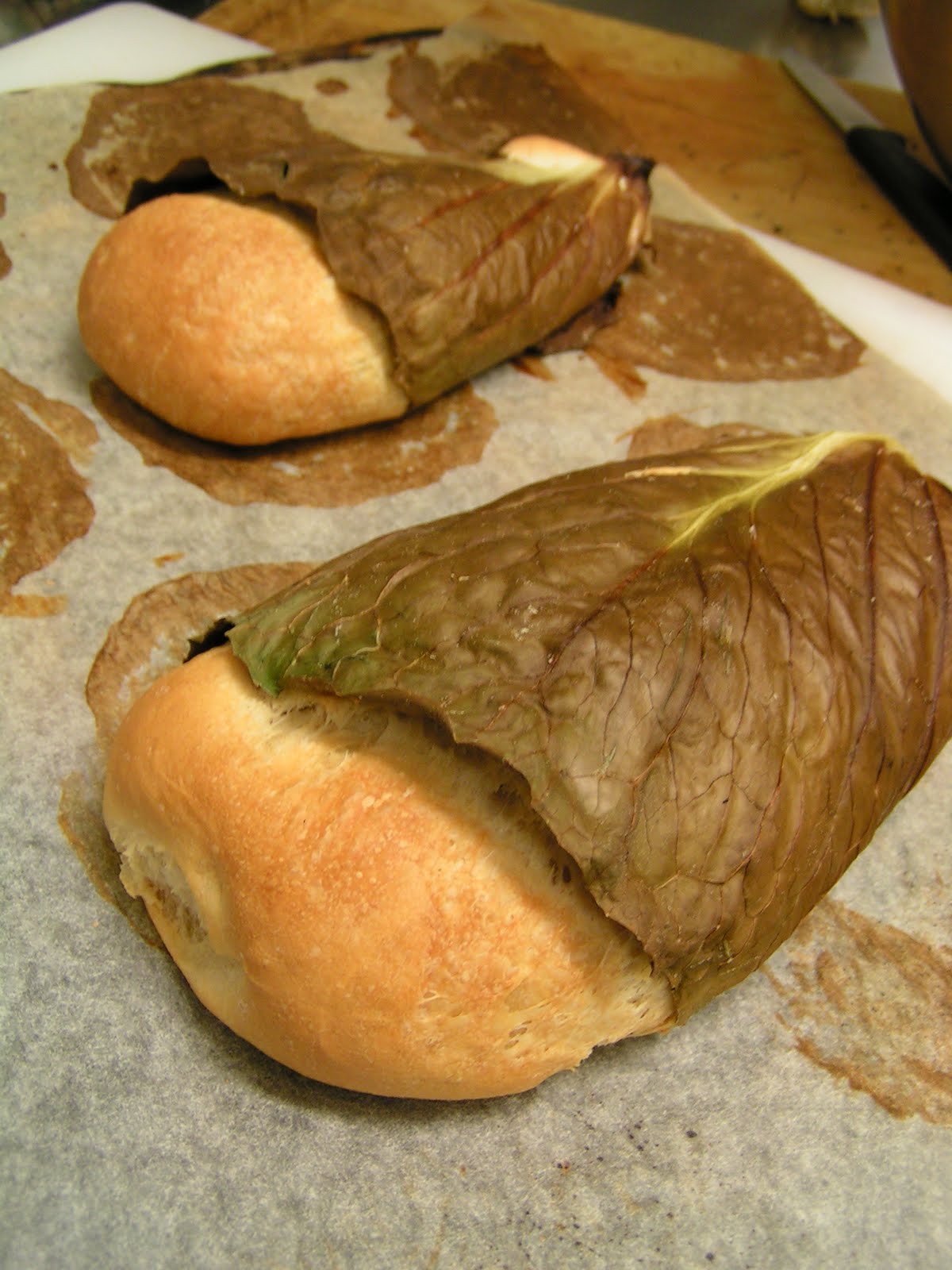
What manner of devilry is this? Triffid spawn? These fanciful looking critters are in fact standard, easily-baked-at-home rolls encased in cabbage leaves, resulting in this cool effect:

I came across the technique while reading an old English cookbook, "English Cookery, New & Old", by Susan Campbell. In parts of Gloucestershire, bakers would wrap bread dough in cabbage leaves before baking. Once in the oven, the cabbage leaves would soften, allowing the bread to expand and become imprinted with the vein pattern of the leaf.
Given that my first task upon arriving at work is to make bread, it seemed the perfect excuse to give it a try.

According to Campbell, the best part of the cabbage are the outer leaves; they're big and will quite comfortably envelop your roll. The side of the leaf facing outwards is where you'll place your roll, being suitably venous and knobbly. Wash your leaves, then pat dry. Trim the stalk at the base of the leaf, or simply remove it depending on size; leaving it in will distort the pattern.

Make your bread dough; allow to rise. Knock back, cut into equal sized portions and roll into, er, rolls. Wrap each roll up loosely in a leaf with everything tucked up underneath; ideally, the weight of the roll will keep everything in place. Place on a tray lined with baking paper, and leave the rolls to prove.

Pop your parcels into the oven to bake. Ordinarily, the rolls I make at the restaurant take around twenty minutes to bake (pre-bake weight of 110 grams). I allowed an extra five minutes baking time, taking into consideration the cover provided by the leaves.
Twenty five minutes later, I opened the oven door to be met by the smell of marmite! The cabbage leaves had blackened, and upon scraping them off, there was a lovely golden crust waiting underneath. I don't think I'd had the leaves tucked in firmly enough because the dough had burst through at one end - no matter. The patterned surface on the crust looked awesome, and the marmite smell from the burnt cabbage leaves could be detected in the crust. Bakers of Gloucestershire, I salute you!


22 comments:
This is so cool!!! I will definitely try once my cabbages are big enough!!!
Ciao
Alessandra
That's a cool idea. I like the pattern. I'll definitely try this out soon !
Actually, my hubby already told me about a similar way they bake the bread with cabbage leaves (in Hungary), but they were underneath the loaf only, giving flavour but not the fun pattern...
Awesome! They look so good; I am tres impressed
That worked quite well. I used a beer bread instead of a plain white dough, but the patterns still came up quite nicely. Though it appears I've still a thing or two to learn about getting the cabbage leaves off and nicely rolled. There was still a hint of something from the cabbage flavour wise but possibly less given the beer.
And texture wise it was almost half steamed/half baked, which was quite nice. Half way between a bun and a bao.
Ta muchly for the idea.
Looks amazing. Have to try it soon.
This is very cool, I love how they look just out of the oven ready to be unwrapped. They remind me strangely of swaddled babies... real-life cabbage patch kids?
Cool! I love that pattern. Interesting that the baked cabbage leaves give off a marmitey flavour.
can always count on you for something a little bit different, i love these :)
What a funky idea, they have some interesting stuff those old books
That bread looks utterly amazing! Would this technique work with most bread recipes?
Lisa - I can't see why not. Several generations of practise by British bakers can't be wrong!
Ali/Paula-Satch/ - Thanks guys :)
Laura - Maybe some chemical in the cabbage enhances the yeast notes present in the bread? Where's a scientist when you need one ;)
MM - God, I remember when the first generation came out when I was a kid; frightening-looking things!
Bronwyn - It's definitely worth a go.
Ben - You're right! I figured they'd be a little under-coloured because they'd be wrapped, so increased the cooking time a tad.
Vanille - Ah... You'd still have a nice, golden loaf too following that method.
Alessandra - Show me pictures when it happens, please :)
HP - Don't they just!
I would like to taste this bread, It is so beautyfull and seems so good!! Bello il tuo blog, un bacione =D
Cheers great find, I baking bread everyday at the moment so will enjoy doing something like this
I'm a Canadian of Ukrainian decent. My mother always baked cabbage bread, but hers (I always thought it was a traditional Ukrainian recipe) also had a filling of dry curd cottage cheese, a small amount of chopped onion, lots of chopped dill leaves, and an egg to hold it together. The filling was wrapped in the bread dough, sealed, then the oval shaped loaf was put seam-side down on a large cabbage leaf which was placed on either Mom's old round cake tins or a tin pie plate. Another large cabbage leaf was then placed over the loaf, and the bread was allowed to rise between the cabbage leaves. When it was baked, the cabbage leaves would not only have given the crust a wonderful pattern and flavour, but also a unique texture from the steam they created while baking. I drool just thinking about this bread, warm from the oven!
I did a miso dough, and it came out smelling wounderful, I just cooked the at too high a temp, will def try again, cheers Nigel
Wow, that is so cool - I can't wait to give that try! Interesting that the blackened cabbage leaves smell like marmite.
Sue :-)
Hi there,
Would you or any person be able to pass onto me a starter rewana bug. I can't for the life of me get on to live longer than 2 days?
Help
I am in Rotorua
Barton - Miso? Awesome, that sounds well worth trying.
Lipstick - Thank you :)
Sue - It's a lovely smell.
Anon 1 - That sounds so flavoursome!
Anon 2 - As soon as it's risen, use it: don't wait.
Mate...seriously the best blog I have ever come across. I am originally from butt f*** nowhere northern Ontario Canada. Raised in a French Canadian traditional household we ate what most would consider "far out" and "no way man" foods. Living off the land and loving every minute of it. I consider myself a Caniwi now but until I read this blog, I had not realized how solid kiwis are so similar to my family. Thanks mate, NZ is even more home to me now because of this blog. Great Job! Cheers CJ
CJ, my pleasure, & thank you.
That's awesome! Long time no hear, glad you come back.
Post a Comment